Horizontal Boring Mill vs Double Column vs VTL
ELK GROVE VILLAGE, IL. — November 6, 2026
Horizontal Boring Mill vs Double Column Machining Center vs Vertical Turning Lathe: How to Choose for Large Parts
Choosing the wrong machine type for a large part rarely shows up on the quote. It shows up later, round parts milled when they should be turned or extra setups that add load time and another chance to lose tolerance.
The rule that holds for most parts: if it spins, turn it on a vertical turning lathe (VTL). If it’s a block with deep bores in several sides, bore it on a horizontal boring mill (HBM). If it’s long, wide or flat and most of the work faces up, put it on a double column machining center.
Shibaura Machine builds all three and this guide explains how each one works, where each one fits, and how to decide when a part doesn’t fit the rule.
What is the difference between an HBM, a double column machining center and a VTL?
All three can cut large metal parts. The difference is how they hold the part and how the tool reaches it.
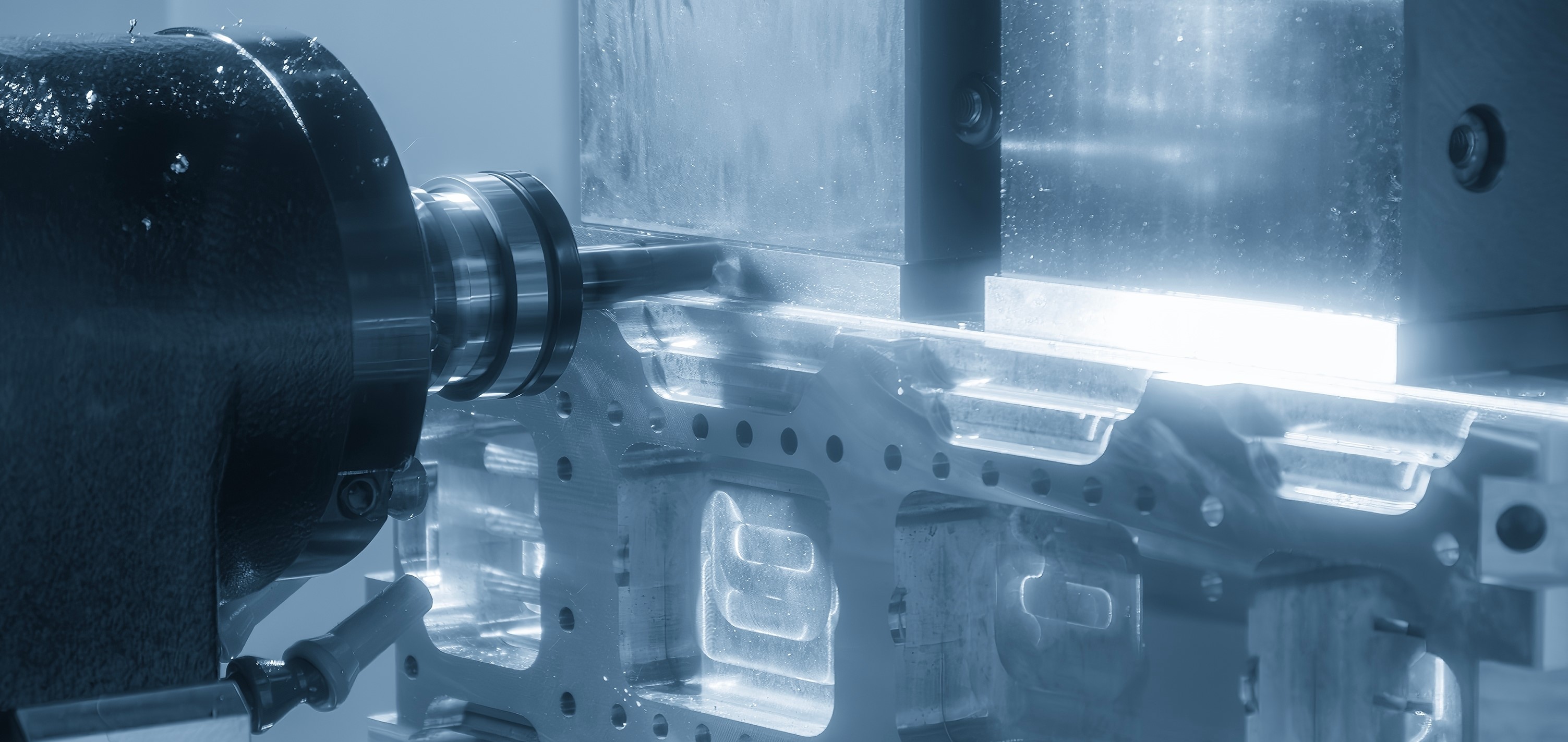
Horizontal boring mill (HBM). The spindle is horizontal and extends out of the headstock on a bar or quill, called the W-axis. That reach lets the tool go deep into a bore without moving the part. The part sits on a rotary table (B-axis) that turns to present each face. HBMs are built for large prismatic work.
Double column machining center. Two columns hold a crossrail, or bridge, over a long table, and a vertical spindle travels across it. The part sits on the table under the bridge. Attachment heads let the spindle reach the sides, so many parts get five faces machined in one setup. You’ll also see these called bridge-type or gantry machining centers.
Vertical turning lathe (VTL). The part lies flat on a large rotating table, and the tools come down from a vertical ram. Gravity helps seat heavy parts, so a VTL can turn large diameters steadily. You’ll also see it called a vertical boring mill or a vertical boring and turning mill. Models with a live spindle and C-axis add milling and drilling.
HBM vs double column vs VTL at a glance
|
Factor |
Horizontal boring mill |
Double column machining center |
Vertical turning lathe |
|
Best for |
Large prismatic parts with deep bores on several faces |
Large, flat or long parts machined mostly from the top and sides |
Large round parts |
|
Typical parts |
Housings, frames, gearbox and pump bodies, split casings |
Machine bases and beds, plates, molds and dies, long weldments |
Rings, flanges, discs, wheels, round casings |
|
How the tool reaches the work |
Spindle extends (W-axis); rotary table indexes each face |
Vertical spindle on a bridge; attachment heads reach the sides |
Part rotates; ram moves tools across and down |
|
Main strength |
Reach, line boring, multi-face work |
Large work areas, five-face machining in one setup |
Fast turning of large diameters, stability on heavy parts |
|
Shibaura series |
BTD, BTH (table type); BF, BSF (floor type) |
MPJ, MPC-EII, MP-(U), MCW |
TUE, TMD, TSS, TDS |
When should you choose a horizontal boring mill?
Choose an HBM when the part is large and blocky, and the critical features are bores. Typical signs:
- Bores that are deep, or that must line up across two or more faces.
- A part that is more block than plate, with bores running into its sides.
- Machining needed on four or five sides in one setup.
Table-type HBMs carry the part on a rotary table that moves. Shibaura’s BTD series includes tables from 39 x 47 inches (BTD-200QS) to 71 x 87 inches (BTD-130S.R22), and the BTH-150.R35 steps up to a 78 x 137 inch table with 236 inches of X travel. Floor-type HBMs, like Shibaura’s BF and BSF series, move the column along a floor runway and leave the part on floor plates, which suits parts too large for any table. Our guide to table-type horizontal boring mills covers how to choose between the two.
When is a double column machining center the better fit?
A double column machine is the better fit when the part is large and relatively flat or long, and its natural orientation puts most of the work on top: machine bases and beds, plates, molds and dies, and long weldments. The part lies on the table the way it naturally rests, fully supported, with the work facing the spindle. A horizontal boring mill would need the same part stood on edge, which takes a bigger fixture and a riskier lift. The bridge spans the part, so the spindle covers a wide area in one setup, and attachment heads reach the sides for five-face machining.
When should you choose a vertical turning lathe?
Choose a VTL when the part is mostly round: rings, flanges, discs, wheels, bearing races or turned casings. Turning a large diameter on a VTL is usually faster, with a better finish, than milling the same diameter by interpolation.
The part lies flat on the table, so its own weight helps hold it steady through heavy cuts. Shibaura’s vertical turning line covers tables from 40 to 156 inches in diameter. The TUE-150(S), for example, has a 57-inch table and a 78.7-inch maximum swing.
Many round parts also need bolt holes, flats or slots. A VTL with a live spindle and C-axis can often finish those in the same clamping instead of sending the part to a mill. Our guide to single-setup machining of large-diameter parts covers how that works.
Five questions to help decide
- Is the part mostly round or mostly flat-sided? Round points to a VTL. Flat-sided points to an HBM or a double column machine.
- Will it fit the machine, not just the table? Compare the part, with its fixture, against the machine’s travels. Then check the limit for each type: clearance as an HBM table rotates, width between the columns on a double column machine, and swing and cutting height on a VTL.
- Where are the features? One face, several faces, or deep inside the part. Deep bores and line boring across faces favor an HBM. Large areas on the top face favor a double column machine.
- Is the part more block or more plate? Tall, blocky parts with bores in their sides favor an HBM. Long, wide or flat parts favor a double column machine, as long as they fit between the columns.
- How will you keep the spindle cutting? Pallet changers, probing and enough tool pockets matter as much as the machine type.
Talk through your part
The fastest way to decide is to look at the drawing. Send it to a Shibaura Machine Tools specialist and we’ll tell you which machine type fits, and which model.
Contact the Machine Tool Sales team at (888) 593-1616 or MT-Sales@shibaura-machine.com, or request information.
Shibaura Machine models to start with
- Table-type HBMs: the BTD series, from the BTD-200QS (7.8-inch quill, 39 x 47 inch table) to the BTD-130S.R22 (5.1-inch spindle, 118-inch X travel), and the BTH series for larger work.
- Floor-type HBMs: the BF and BSF series on the horizontal boring mill page.
- Double column machining centers: the MPJ, MPC-EII, MP-(U) and MCW series on the double column machining center page, built for five-face machining of large parts.
- VTLs: the TUE series plus the TMD, TSS and TDS series on the vertical boring and turning mill page, including live spindle models.
Shibaura Machine has supplied machines to North America since 1975 and keeps an extensive inventory of machines here for quick delivery.
Frequently asked questions
What is the difference between a horizontal boring mill and a double column machining center?
A horizontal boring mill has a horizontal spindle that extends (the W-axis) and a rotary table, built for deep bores on several sides of large prismatic parts. A double column machining center has a vertical spindle on a bridge over a long table, built for large, flat or long parts machined mostly from the top, with attachment heads for the sides.
When should I use a VTL instead of a horizontal boring mill?
Use a vertical turning lathe when the part is mostly round, such as rings, flanges, discs and turned casings. The rotating table turns large diameters quickly, and gravity helps seat heavy parts. If the round part also needs holes or flats, a VTL with a live spindle and C-axis can often finish it in one setup.
Is a vertical boring mill the same as a vertical turning lathe?
Yes. Vertical boring mill, vertical boring and turning mill, vertical lathe and VTL all describe the same machine: tools on a vertical ram working a part that rotates on a horizontal table. Shibaura Machine calls its line Vertical Boring & Turning Mills.
Can a horizontal boring mill machine round features?
Yes, within limits. An HBM can mill round features by interpolation, and Shibaura’s BTD models include a rotary milling function that machines cylindrical and end surfaces with continuous B-axis indexing. For parts that are mostly round, a VTL is usually faster.
What is a double column machining center used for?
A double column machining center is used for large, flat or long parts that need most of their machining on the top face, such as machine bases and beds, plates, molds and dies. A vertical spindle on a bridge covers a wide work area, and attachment heads reach the sides, so many parts get five faces machined in one setup.
Contact us at at (888) 593-1616 or mt-sales@shibaura-machine.com.